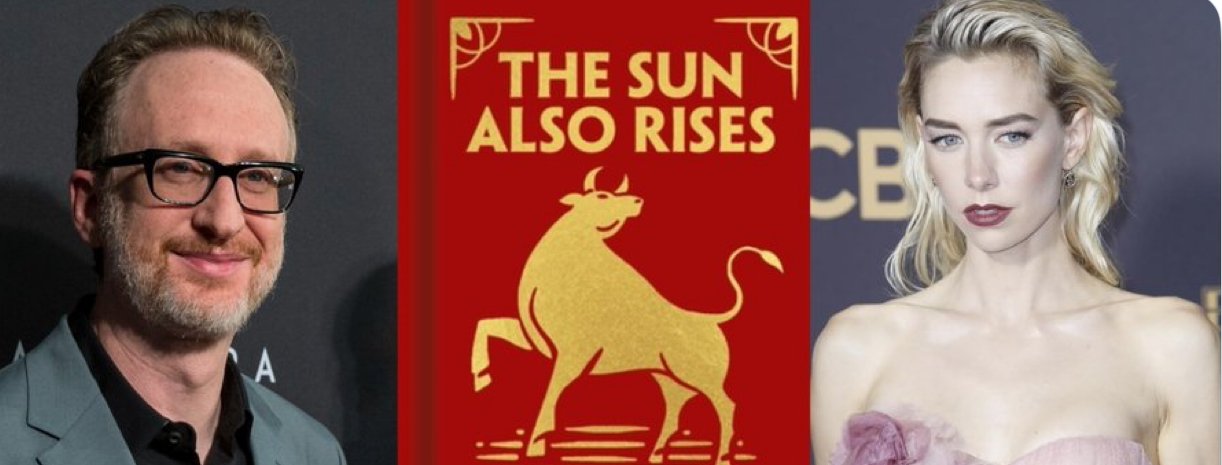
Ernest Hemingway feature in works with great-granddaughter Dree Hemingway aboard as executive producer
Share Post
Actress and model Dree Hemingway (Starlet) is set to executive produce a new film about her legendary great grandfather, Ernest Hemingway.
The Hemingway Files will follow the writer’s last years, as his closest friends A.E. Hotchner and Duke MacMullen help him navigate his deepening mental struggles, his strained relationship with his trans daughter Gloria Hemingway, and the growing paranoia surrounding his belief that the FBI, under the direction of J. Edgar Hoover, was watching him.
The film is produced by Jeremy Bolt (Resident Evil) and will be directed by Jessica M. Thompson, whose projects include SXSW-winning debut The Light of the Moon, Screen Gems thriller The Invitation, which made $38 million global, and Showtime series The End.
The project is being produced under JB Pictures. Script comes from Cory Todd Hughes and Adrian Speckert (Armor). The film is currently in development with casting discussions underway.
Hemingway is the totemic U.S. author, Nobel Prize winner and larger-than-life personality known for novels including The Sun Also Rises, A Farewell to Arms, For Whom the Bell Tolls and The Old Man and the Sea.
Dree Hemingway, who has starred in films including Sean Baker’s Starlet and Noah Baumbach’s While We’re Young, said: “My great grandfather’s story has been told many times but rarely with this level of empathy and honesty. The Hemingway Files is about understanding him not as an icon, but as a father, a friend, and a man trying to hold on to himself.”
“This is one of the most important scripts of our lives,” Hughes and Speckert said in a joint statement. “Dree Hemingway’s support and trust in this project mean the world to us. We feel a deep responsibility to tell the truth of what Hemingway endured in those last years, his battles with his mind, his government, and his heart. The world deserves to know who he really was beneath the myth.”
Thompson said her vision is to approach Hemingway’s decline “with empathy and honesty. I want to peer underneath the mask of Hemingway’s legend and lay bare the truth of this multifaceted artist. I’m fascinated by the intersection of myth and reality. Hemingway’s story isn’t just about a writer grappling with obsolescence, it’s about the cost of masculinity, the fragility of family, and the truth that even the strongest among us can struggle.”
Several screen projects have explored Hemingway’s life including the 2012 HBO film Hemingway & Gellhorn, the 2015 movie Papa: Hemingway in Cuba and the 2021 Ken Burns documentary series Hemingway.
I remember reading Hemingway in high school American lit class: The Sun Also Rises , “Hills like White Elephants,” and maybe some others – I don’t remember everything we read there. He wasn’t my favorite author, but he wasn’t anywhere near the worst we read that term. I remember his sparse, bald style – which went well with the sparse baldness of his themes.
So, when I read Ozy Brennan’s recent post “Reject Hemingwayism“, I immediately had a lot to say. I agree with Ozy on a lot of points, but there are some important points that writers should learn from Hemingway. Hemingway did write well – and he wrote a specific type of story, but there are still some good lessons to take from him more generally.
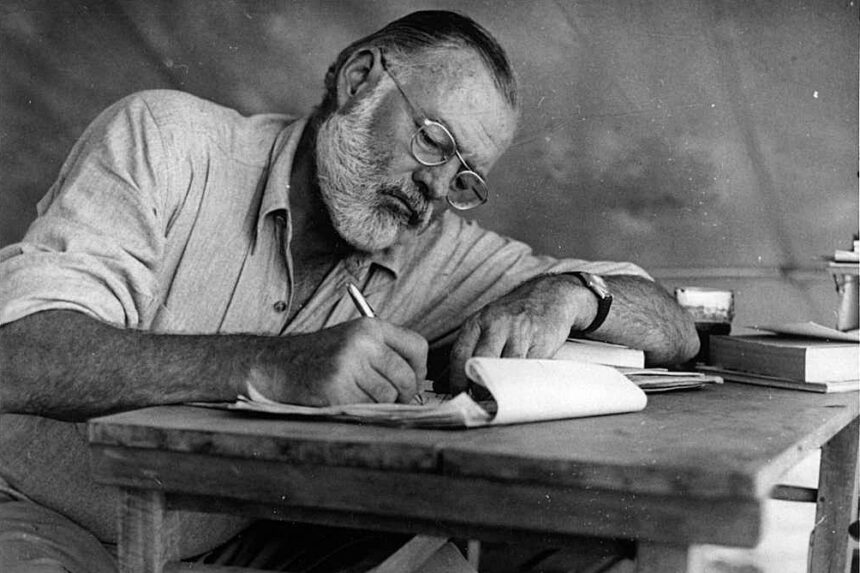
Ernest Hemingway. Is this man to blame for all the bad things in modern literature?
To start with, I agree with Ozy against Hemingway that writers shouldn’t hesitate to show melodrama.
Hemingway’s stories are a specific sort of story. He was trying to write bald stories with bald facts and setting, to show the world as it is rather than as it might be dressed up to be. “Many are strong in the broken places,” as he said in Farewell To Arms.
And to him, and to the Lost Generation of which he was a member, they must first come to terms with the brokenness as it is. Melodrama was meaningless, lost in the carnage and waste of World War One. His characters don’t cry, because they’ve been through far worse. His readers don’t expect them to cry, because they the readers have also been through far worse.
But to those of us who haven’t survived the trenches of Flanders, melodrama can still have power. Even among Hemingway’s fellow soldiers, some – like J. R. R. Tolkien – came out of it with a different perspective. Tolkien’s characters weep, for “not all tears are evil”. They, like Tolkien himself,do find some higher hope beyond the Dead Marshes or the deathly trenches. This builds a different type of story, and one I very much appreciate.
Hemingway-style restrained characters definitely do have a role. When I was acting in my first amateur theater play as a teenager, my dad introduced me to the effect of understated emotion. I was playing a butler in this one scene, with just a few lines in the background – and my first impulse was to visibly react to the events on stage, but my dad showed me how much power there can be just a few raised eyebrows and understated reactions.
It can be almost as powerful in print as on the stage. But not every character should be that way. In fact, such characters – like Mr. Spock in Star Trek – can be even more powerful when contrasted with more-emotional characters around them. As scriptwriter David Gerrold said, Spock’s lack of emotion is good specifically because of the emotion it evokes in the other characters.
(Is this masculine, as Ozy suggests some think? A certain sort of masculinity, probably. But the entire medieval tradition to which Tolkien was alluding practices a different sort of masculinity.)
Hemingway doesn’t show this contrast. He’s going for a different sort of effect – and he does it well, but it’s an effect I don’t care to read that often. I certainly don’t want every book to have that effect, either.
Hemingway’s style of words, though, is more complicated.
“It’s true,” Ozy says, “that adverbs and adjectives can be crutches used to sustain a weak noun or verb: “he went slowly” instead of “he strolled.”” And therefore, Hemingway’s famous writing advice is to find the right noun and verb rather than dressing up a weak one. Against this, Ozy holds up several example passages, and concludes “English didn’t evolve several parts of speech, multiple punctuation marks, and half its vocabulary because they’re stupid useless things that no good writer would employ.”
I agree, as such. However, this’s minimizing the importance of Hemingway’s advice. As Twain put it, “The difference between the almost right word and the right word is… the difference between the lightning bug and the lightning.” Finding a strong word is much stronger than dressing up a weak word. Ozy quotes good authors who use adverbs and adjectives well, but this’s much more important for newer authors who don’t necessarily have the talent to tell how to use them very well.
Before my high school lit class where I encountered Hemingway, I read a writing advice column – I don’t remember by whom – which gave the same advice: don’t dress up weak words, but use strong words. I still agree.
To pick one of the writers Ozy quoted, Tolkien: there’s a reason we remember lines like “Renewed shall be blade that was broken; the crownless again shall be king.” There’re only two adjectives in that couplet; one of them (”broken”) is a participle and the other (”again”) tells us the order of events. None of these words are “fancy Latinate words” or otherwise unusual; like Hemingway, Tolkien is giving us sparse, simple language.
Tolkien is using simple language here for a reason – or specifically, two reasons. In-universe, this’s a poem composed by Bilbo the Hobbit; Tolkien is doubtlessly making a point of having him use simple language hearkening back to the simple Shire. Beyond that, it’s a poem composed about Aragorn who is the lost king returning to his throne; the simple language casts our minds toward the simple ancient fairy-tale theme.
Complex language wouldn’t fit the same.
Tolkien does this very well throughout his works. He uses unusual sentence constructions, but usually simple sentences. For example, when the Fellowship is leaving Rivendell:
The Company took little gear of war, for their hope was in secrecy not in battle. Aragorn had Anduril, but no other weapon, and he went forth clad only in rusty green and brown, as a Ranger of the wilderness. Boromir had a long sword, in fashion like Anduril but of less lineage, and he bore also a shield and his war-horn.
What adjectives are here? Few, and ordinary. The continued simple words have their own effect. The old-fashioned constructions (like “their hope was in secrecy” or “he bore also”) give us a different sort of effect that doesn’t violate Hemingway’s rules and is even stronger because of it.
In fact, it’s much briefer on the page than it might seem in our memory. The description of Cerin Amroth which Ozy quotes is one short paragraph, but as Tolkien scholar Michael Martinez puts it, “Tolkien’s conciseness in sharing details provides that illusion of long writing.” It looms much larger in our memory than on the page, because of Tolkien’s strong words.
Hemingway around 50 years old
Hemingway used his simple language to the same purpose as his characters’ lack of emotion. After the carnage and waste of World War One, pretty language was a mere window-dressing on the hard world. Again, he achieves this well – yet other books are trying for other purposes.
So, it might seem proper for people writing different themes to use different styles. As Ozy says, Catherynne M. Valente’s Space Opera reads differently from a more bald factual stating of the Fermi Paradox.
I agree! This is a corollary of the narrator being a character in your story. Your narrator shouldn’t be Hemingway’s narrator, unless you’re writing a story where Hemingway’s narrator makes sense.
Yet one must not forget the lessons of Hemingway’s style.
Finding the right words means something. Even if you’re writing a passage as ponderous with adjectives and adverbs as Gormenghast , finding the right nouns and verbs matters. Or, to take Ozy’s other quote, from Tolkien: Aragorn “ was wrapped in some fair memory,” and “ the grim years were removed from the face of Aragorn, and he seemed clothed in white”. Note the strong participle “wrapped” and the classical “clothed” rich with connotations (including Biblical connotations which I think Tolkien fully intended here.) I don’t see many adjectives and adverbs or advanced constructions here. In fact, Tolkien’s prose seems almost as bald as Hemingway’s!
Ernest HEMINGWAY during Spanish Civil War. In December 1937 Ernest Hemingway was covering the Loyalist assault on Teruel, the walled town in the bleak mountains of Southern Aragon, Gen. Franco was planning to use this corridor route to the Mediterranean thus seaparting Barcelona from Valencia and Madrid. Robert CAPA the photographer and Hemingway would with some colleagues drive daily to Teruel from Valencia and return each evening. Valencia. Dec. 1937. Hemingway visiting the front line.
Thanks for reading Papyrus Rampant! Subscribe for free to receive new posts and support my work.
Ozy laments Hemingway’s influence on modern prose.
When I tried to think of examples, for a while, I couldn’t. I wished Ozy had pointed out more examples. Maybe that’s because I don’t read the same sort of books – I definitely know I haven’t read much “literary fiction”. But if there’s a parade of authors aping Hemingway’s style – I haven’t seen it.
(Or, well, I have seen it in one place: amateur authors writing online what might be their first-ever stories. Sometimes, they tack much too far into Hemingway. But other times, they tack much too far into the opposite pit-trap and drown us under a tsunami of adjectives and adverbs.)
But then I reread Ozy’s post and realized: I’m not noticing Hemingway’s influence because I’m already swimming in it.
Though modern novels haven’t aped Hemingway’s style, they’ve been influenced by it: they’re much balder than nineteenth-century novels. Modern novels – even Valente – use fewer adjectives, and less melodrama, than (say) Charles Dickens or Jules Verne. This probably isn’t just Hemingway – Hemingway was one exemplar of a movement around his time – but Hemingway can be a synecdoche for this very real movement.
Is this a bad thing? Probably. On the one hand, modern authors are building off a longer tradition than Dickens, so they can do things more artfully (just like I discussed about playwrights earlier). If authors can produce more sentiment and more vividness with fewer narrative asides and fewer individual adverbs, that’s not bad. But looking back, I do feel the effect built by modern novelists is poorer in some ways. Imagine A Tale of Two Cities without the narrative comments, or the famous beginning!
Modern readers don’t expect the melodramatic effect or description of Dickens or Verne. Even when they’re reading melodrama, it’s not the same sense of melodrama.
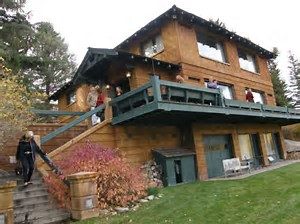
One of my favorite photos of Hem, Idaho
More melodramatic than anything in Hemingway… or since Hemingway?
But, that tide can shift. But I wonder how the sentimental ear of Dickens’ narrators would feel to a modern audience. If it’s artfully written, especially if the narrator is characterized well themself, I suspect it could go well.
So, to aspiring writers, Hemingway does have at least one important lesson: use vivid nouns and verbs, without depending on adjectives or adverbs to dress up weak words.
But at the same time, all in all, I agree with Ozy on a literary level: Hemingway’s influence has been too great.
Hemingway writer and scholar, Curtis DeBerg, has brought forward an amazing note of Hemingway history that gives us insight, raises questions, and informs what we may think about Hemingway’s end.
In a New York Times Article published January 23, 2026, John Rosengren covers the discovery of an inscription that Hemingway wrote by hand on June 16, 1961. He killed himself on July 2, 1961 with a gunshot. Hemingway who was at the Mayo Clinic receiving treatment for depression at the time he wrote an inscription in “The Old Man & The Sea” to one of the nuns who was caring for him named Sister Immaculata. For those of us who read and love Hemingway, it is profound. It reads as follows:
“ To Sister Immaculata: this book, hoping to write another one as good for her when my writing luck is running well again, and it will.”
Ernest Hemingway, St. Mary’s, June 16, 1961”
Hemingway entered a psychiatric unit at St. Mary’s Hospital affiliated with the Mayo Clinic in November of 1960 and stayed until almost the end of January 1961. He received electroshock therapy and returned to the facility in April 1961 for additional care. The public was unaware of his condition and his wife Mary signed him in claiming it was for high blood pressure.
Hemingway was released by the chief psychiatrist claiming that he was well enough to go home. He lived in Idaho at that point.
Here is where Curtis DeBerg comes in. The book appears to have been largely forgotten until 5 years ago when one of the Sisters mentioned it to Curt who was doing research at the Mayo Clinic. At the time, Curt thought, “Was he kidding himself thinking he was going to be able to write again after all those electroshock treatments or is he thinking in the back of his mind “I’ll never write another book like this.””
Until now, the book with its inscription was locked up and largely forgotten on the shelves in the library at St. Mary’s Hospital. Five years ago, one of the Sisters mentioned it to Curtis DeBerg who has written two books about Hemingway and was doing research at the Mayo Clinic. DeBerg who wrote “Traveling the World with Hemingway” and the more recent “Wrestling with Demons” also about Hemingway, appropriately said more people should see this and it’s a part of very important Hemingway history.
DeBerg wonders if Hemingway was kidding himself thinking he was going to be able to write again after all those electric shock treatments or was he thinking in the back of his mind “I’ll never write another book like this.” He also ponders if the sunniness of the note was designed to convince the Mayo Clinic doctors that he was ready for release which he was not.
When DeBerg toured the Nobel Prize museum and learned it had no Hemingway artifacts he suggested the Franciscans donate at St. Mary’s the book. The order’s Leadership Counselor agreed to do so and turned it over to DeBerg in November. At the ceremony in Sweden on January 23, DeBerg discussed the inscription’s significance and it will now rest at the museum.
Endless gratitude to Curtis DeBerg for seeing the book and its inscription and making it known to the rest of the world. Even in his despair or hope depending on how you see this, Hemingway showed kindness and gratitude to Sister Immaculata which was the flipside of his aggressive side and what I like to think is his true, mid-western nature.
What a find! So much to think about and discuss.
With much gratitude to Curt who brought this to my attention. Thank you, Curt, for your dedication to Hemingway’s memory.
The United States boasts a rich history of Nobel laureates whose achievements have profoundly influenced science, literature, and peace. These exceptional figures, including pioneering scientists, visionary writers, and inspiring leaders, represent America’s innovation and commitment to progress. Their remarkable accomplishments and lasting legacies have advanced human knowledge and inspired generations to strive for a better world.
The United States has a historical reputation for being home to some of the most eminent Nobel Prize winners internationally, whose paths of achievement have impacted the progress of the world in science, literature, peace, and more. These exceptional figures represent America’s innovation, leadership, and creativity. They include pathfinding scientists, visionary writers, and inspiring leaders whose commitment to peace and equality has informed the course of humanity.
Each Nobel laureate has improved the state of human knowledge and inspired each new generation to dream a little bigger and achieve more towards making the world a better place. The following list of the top 10 famous American Nobel prize winners highlights the remarkable accomplishments and lasting legacies of those shifted the course of history through their brilliance and purpose.
Top 10 Famous American Nobel Prize Winners
Here are the top 10 famous americans who have won nobel prize along with the year of their achievement and field in which they have specialised:
No.
Name
Year
Field
1
Martin Luther King Jr.
1964
Nobel Peace Prize
2
Barack Obama
2009
Nobel Peace Prize
3
Ernest Hemingway
1954
Nobel Prize in Literature
4
Richard P. Feynman
1965
Nobel Prize in Physics
5
John Bardeen
1956 & 1972
Nobel Prize in Physics
6
Bob Dylan
2016
Nobel Prize in Literature
7
Toni Morrison
1993
Nobel Prize in Literature
8
Albert A. Michelson
1907
Nobel Prize in Physics
9
Henry Kissinger
1973
Nobel Peace Prize
10
Frances H. Arnold
2018
Nobel Prize in Chemistry
1. Martin Luther King Jr. – Nobel Peace Prize (1964)
Dr. Martin Luther King Jr. received the Nobel recognition Nobel Peace Prize for his nonviolent fight against racial injustice and segregation in the United States. Through his example as a gifted orator and a leader of the Civil Rights Movement, he personified the ideals of human rights, justice, and treatment commensurate with equality and peace around the globe. King’s inspired words and nonviolent action made him a universal moral voice of the age and etched his legacy in the U.S. and world history.
2. Barack Obama- Nobel Peace Prize (2009)
Barack Obama was awarded the Nobel Peace Prize for his efforts to strengthen diplomatic relations and collaboration among countries. He was recognized for his vision of a future where nations would not possess nuclear weapons or be defined by borders.
Obama emphasized the need for dialogue rather than the pursuit of war and fought for the ideals of hope and change. He promoted peace, dialogue with inclusion, and finding avenues for cooperation and commonality to the forefront of the world stage.
3. Ernest Hemingway – Nobel Prize in Literature (1954)
For his remarkable prose and simple style, Ernest Hemingway received the Nobel Prize in Literature, particularly spotlighted through The Old Man and the Sea. Hemingway’s stories displayed themes of courage, perseverance, and struggles of humanity.
His distinctive style changed the course of modern stories, and influenced both writers and readers throughout the generations, through his straight forward style of a powerful story that portrayed the truth of dealing with life and humanity.
4. Richard P. Feynman – Nobel Prize in Physics (1965)
Famous physicist Richard P. Feynman received the Nobel Prize in Physics for his transformative research quantum electrodynamics. His research changed the way particles behaved and interacted with electromagnetic behaviors in particles.
Along with his research, Feynman became famous for his entertaining and informative lectures, his quick wit, as well as the spirit of curiosity-driven science. Feynman became an inspiration for countless generations of students and scientists in college and universities to examine the universe with creativity and wonder leading to a lasting impact on physics.
5. John Bardeen – Nobel Prize in Physics (1956 & 1972)
John Bardeen is the only person ever to be awarded the Nobel Prize in Physics, twice. The first was awarded for his invention of the transistor, which changed the electronics industry and eventually opened the door to modern computing. The second honored his theory of superconductivity. Bardeen’s inventions changed technology and industry and positioned him as one of the most important scientists in modern history.
At Pamplona’s San Fermín festival, a tiny minority of women run with bulls
Show all 4
Dressed in the traditional bull runner’s garb of a white shirt and red neck-scarf, Yomara Martínez, 30, sprinted in the death-defying morning run or “encierros” taking place this week in the northern Spanish city of Pamplona.
Yet despite being in a crowd of thousands, Martínez was among only a handful of women daredevils running with the stampeding bulls at the San Fermín Festival.
“At the end of the day, the bull doesn’t know about sexes, age or body shape,” Martinez said. “It doesn’t matter if you are woman.”
Every year, thousands of people line the medieval streets of Pamplona to witness the centuries-old tradition of running with bulls. Many watch from balconies and wooden barricades along the course. Millions more follow the spectacle on television.
Women bull runners are rare, though Martínez and other women taking part in the adrenaline-fueled tradition as more than mere spectators say it’s growing in popularity.
“There are times I feel small. And ask myself ‘what am I doing here?’ Because, although you may not want to, you do feel slightly inferior because of your physique,” said 32-year-old Sara Puñal, an administrator who took part in Sunday’s run.
“But in the moment, you are all equal,” Puñal said of the run.
The bulls pound along the twisting cobblestone streets after being led by six steers. Up to 4,000 runners take part in each bull run, which takes place over 846 meters (2,775 feet) and can last two to four minutes.
The expert Spanish runners try to sprint just in front of the bull’s horns for a few seconds while egging the animal on with a rolled newspaper. Gorings are not rare, but many more people are bruised and injured in falls and pileups with each other.
“I think many have a desire to see what it feels like but they don’t try because of fear,” said Paula López, 32, a shop assistant who also took part in a run earlier in the week. López said she grew up in the masculine world of bull fighting. She wasn’t fazed by how few women take part in the event.
“It’s complicated, but it is pretty exciting,” López said.
The event’s reputation took a hit years ago following complaints by women about having suffered sexual harassment and abuse from revelers.
In 2016, five men raped an 18-year-old woman during the festival in an infamous case that sparked an outcry across Spain. The men, who had a WhatsApp group named “La Manada,” or “The Animal Pack,” were imprisoned for 15 years by the Supreme Court in 2019.
Since then, organizers have said they’ve stepped up security measures.
Women didn’t participate in the bull runs until 1975 due to a decree repealed one year earlier that prohibited women, children and the elderly from being in the streets where the bulls run during the festival.
The spectacle was made internationally famous by Ernest Hemingway’s classic 1926 novel “The Sun Also Rises,” about American bohemians wasting away in Europe.
Hemingway Presentation Copy of The Old Man and the Sea Inscribed to Spencer Tracy Sold for $83K
BONHAMS
Ernest Hemingway’s The Old Man and the Sea with inscription to Spencer Tracy
Leading Bonhams’ ‘white glove’ Spencer Tracy: Collection of a Screen Icon auction was an advance issue presentation copy of The Old Man and the Sea by Ernest Hemingwaywhich soared to more than 55 times its estimate when it sold for $83,050.
One of only 30 pre-publication copies printed in August 1952, this example is one of just two known copies inscribed by Hemingway bearing a personal inscription to Spencer Tracy who would later portray Santiago in the 1958 film adaptation.
Other major standouts from the sale included:
a first edition, presentation copy of John F. Kennedy’s first book, Why England Slept(1940), inscribed to Spencer Tracy, which sold for $15,360, more than seven times its estimate
a painting by actress Katherine Hepburn ($9,600)
Peter Pan and Tinkerbell reproduction celluloid print from the Disney Peter Pan movie, signed by Walt Disney Disney, 1953 ($9,600)
Opera fans know the names of the medium’s greats: Puccini, Mozart, Verdi. But what about Hemingway?
On Oct. 10 and 12, visitors to the Wexner Center for the Arts at The Ohio State University can see an opera adaptation of “The Old Man and the Sea,” one of Ernest Hemingway’s novellas.
“When Beth Morrison Projects first pitched “The Old Man and the Sea,” I immediately knew it was the perfect piece for our first collaboration with the Wexner Center,” said Julia Noulin-Mérat, general director and chief executive officer of Opera Columbus. “What captivated me was how it blends cinematic video design with a meditative score – it feels as much like an immersive art installation as an opera. Partnering with the Wexner Center for the Arts and Ohio State makes perfect sense because this production lives at the intersection of opera, film and contemporary art.”
The show first ran in 2023 at Arizona State University’s Gammage Auditorium. Elena Perantoni, senior producer at the Wexner Center, saw it last year in Chapel Hill, North Carolina.
“I was floored,” she said. “This is contemporary opera. It is engaging in the way we want contemporary art to be: a commentary on our current lives and our world.”
The 90-minute opera, by Paola Prestini, Royce Vavrek and Karmina Šilec, is based on Hemingway’s story about a fisherman chasing one last catch. Interspersed through the original story are portraits of everyday life that examine aging, legacy and humanity’s relationship with the ocean.
Still from ‘The Old Man and the Sea’
The performance could not have come to Columbus without internal and external partnerships, Perantoni said. Co-presented by the Wexner Center and Opera Columbus, the piece is also produced by the Beth Morrison Projects.
Inside the university, the Wexner Center was joined by the Office of Academic Affairs and the School of Music in developing the performance opportunity.
“This breathtaking production is a perfect extension of the many ways in which the Wexner Center for the Arts supports students and faculty. We are committed to inviting and ensuring that our campus communities are engaged with every part of the multidisciplinary contemporary works of art that we carefully choose to present,” said Gaëtane Verna, executive director of the Wexner Center. “Co-producing with Opera Columbus and receiving the invaluable financial support of the Office of Academic Affairs was essential to our ability to present and share this bold and captivating new original production from Beth Morrison Projects, which reimagines Hemingway’s iconic story from a new perspective.”
Music students had a special opportunity.
“In addition to the four main characters, there is a chorus of 16 people,” Perantoni said. “Many of those roles are cast locally, including from the School of Music. The others are community members with ties to the university – alumni, faculty, staff and others.”
Increasing student access to artists is a focus for Perantoni, she said.
“How can we bring students in to see how artists work? How can we bring artists to classrooms to talk to students?” she said. “We’ve had a lot of luck with that kind of engagement. We look for every opportunity where students can engage with artists. It’s a core part of the Wexner Center.”
Sidra Bell, graduate research associate in the university’s dance department and The Wex’s presenting team, serves as an artistic collaborator with the directing team. She has been with the production since its early days in 2023 and has worked for director Karmina Šilec as a consultant since 2015.
By including locals in each performance, she said, the show has a specific flavor.
“It’s exciting that every city has a different chorus,” she said. “The leads stay the same. The show becomes this web of new perspectives.”
The staging of the show is also different from a typical opera. Actors move around, and sometimes in, pools of water.
“There is quite a bit of water on the stage,” Perantoni said. “That’s a technician’s worst nightmare. Microphones and electrical cords don’t mix with water. Luckily, Beth Morrison Projects has already figured this out. We’ve kept everyone safe.”
Bell took special care to mitigate risk for the dancers interacting with the water on stage.
“There’s always risk in movement work,” she said. “To avoid injury, the chorus is organized in a specific way and follows a specific path.”
Audience members don’t need to worry about bringing plastic ponchos, Perantoni said.
“No water comes off the stage,” she said. “There’s no splash zone.”
Performances like this are why Bell came to Ohio State to pursue her doctorate.
“Ohio State has this reputation of being on the cutting edge of dance,” she said. “There’s a lot of opportunity here.”
In fact, Bell’s coursework allows her to appreciate her opera experience from an academic perspective as well as a creative one.
“I’m taking a music history class and we’re getting into the origins of opera,” she said. “I’m actually practicing the things that we’re talking about in my classes. It’s amazing. I’m very lucky.”
A walk through India’s first psychology-themed park
Psychopark in Thiruvananthapuram turns the science of the mind into an immersive, interactive experience.
Dopamine house at Psychopark
Ever seen Virginia Woolf, Vincent van Gogh, Ernest Hemingway, Kevin Carter, and Rajalekshmi in one room, all passionately discussing life, despair, and how suicide is never the answer? Wondering how different it might have been if they had held on for just one more moment?
Step out, and the doors open to a house full of walls glimmering with 25,000 tiny sculptures representing the chemical that keeps us moving and feeling — the dopamine house. Charts and displays explain what happens when there is too much or too little of it, how imbalance can twist the way people think or act.
And that is just one corner of this two-acre world, the Psychopark. Half an hour’s drive from the city, along a winding road that weaves through the hills and calm outskirts of Thiruvananthapuram, stands this unique park in Vellanad — India’s first psychology-themed park.
“It’s not just India’s first, this is the world’s first psychology-themed park. It is also an edutainment park,” says C Lekha, CEO of the establishment.
“Mirror For Your Mind, that’s our tagline. Everything here is curated with great care, designed for anyone who wants to understand the human mind and behaviour through engaging, relatable experiences,” she adds.
Neuropsychology, he explains, is at the heart of the park’s vision. It’s important because when people begin to understand how the brain functions, they can free themselves from superstition. “After all, the notions of god and evil both arise within the brain, and recognising that is the first step toward a more rational, enlightened, developed society,” says Madhujan, who is also a recipient of the 2018 National Award for Outstanding Achievement for his work in preventing alcoholism and substance abuse.
The exhibits here unfold like chapters in the human mind. It begins with early practices from the extraction of the stone of madness — a sculptural interpretation of the ancient trephination process of drilling or scraping a hole in the skull — to depictions of traditional Indian approaches to mental illness.
Other sections turn psychology into an interactive experience. Instruments for colour-deficiency tests, maze learning, and depth perception are displayed alongside spaces dedicated to cognitive behaviour therapy and addiction studies.
Had his routines.
The Brain Museum details the brain’s regions and their functions, while the Psychosocial Museum houses artefacts that trace human evolution. A portrait drama theatre, a library with a curated collection of books, an art gallery, a corner dedicated to Sigmund Freud, a nano-sculpture, and photographs of pioneers who shaped modern psychology are also part of the experience.
“The official inauguration has not been held yet. We hope to do it by January and are waiting to confirm a prominent guest,” says Madhujan.
They also have further ambitious plans for Psychopark, including a brain installation that visitors can walk through. A section dismantling pseudo-psychology is also in the plans.
“We are also working towards promoting psycho-tourism,” Madhujan says. “This concept can promote mental and emotional awareness, which is more important today. It can grow even bigger than health tourism. It is an innovative idea, which is perhaps why convincing the state government has been a challenge so far. But hopefully, that will change soon,” he says.
The visit to Psychopark is designed as a complete experience. “People usually come in groups and spend the entire day here,” says Lekha. “From 10 am to 6 pm, visitors are guided by curators who explain each concept in detail. This is not a place to just stroll through — it’s an immersive journey meant to engage and educate.”
Nitty-gritties
After the tour, visitors can also interact with the director and ask questions about any aspect of the human mind. Entry packages start at I650 for adults, I600 for college students, I500 for high school students, and I450 for school groups. The fee includes a traditional mini-sadhya with payasam, along with tea and snacks. For outstation visitors, overnight stays are available for I1,600, which includes accommodation, four meals,
and a campfire experience.
‘Who Murdered the Vets?’ – 1935 US Labor Day Hurricane 90 years on
Wreckage and destroyed homes in the Florida Keys after the hurrican. Photo: Public domain
Scott Jones
Smoking cigarettes and having a drink cooling off after a long day’s work in the tropical sun back at camp, veterans building a highway to connect the Florida Keys to the mainland in September 1935 noticed the wind picking up, and heard reports of bad weather on its way. The next morning “not a blade of grass” remained.
The Labor Day Hurricane of 1935 was the most intense Atlantic hurricane on record, only broken over 50 years later, culminating in a devastating storm surge that swept all before it. Unfortunately, almost 700 workers, World War One veterans, were before it, with only “match-box wooden shacks” for shelter.
Among the first to turn up and aid with rescue and recovery, and to witness the horrific catastrophe, was writer Ernest Hemingway who lived in Key West and owned a fishing boat. He had also served and was wounded in World War One giving him a connection to these vets. Writing that same month in the socialist magazine New Masses, Hemingway hammers out on his typewriter his most impassioned and hard-hitting non-fiction work, “2,800 words of dynamite”, as he later called it.
Under the headline: “Who Murdered The Vets?” he contrasts the “wealthy people… such as President Hoover and President Roosevelt” who “do not come to the Florida Keys in hurricane months” because they know of the danger to their yachts and themselves, with the vets who had no choice and knew no better. Hemingway writes scathingly: “Veterans, especially the bonus-marching variety of veterans are not property. They are only human beings and all they have to lose are their lives.”
It was not until late the next day after the hurricane that any boat could get to Matecumbe Key where the camps were. What they found were hundreds of dead veterans in grotesque states and places. They had nowhere to shelter and nothing to stop them from being washed away. Hemingway said: “You found them everywhere and in the sun all of them were beginning to be too big for their blue jeans and jackets that they could never fill when they were on the bum and hungry… I would like to make whoever sent them there carry just one out through the mangroves.” Some of the surviving vets compared it to what they had seen during the war.
The veterans were there as part of President Franklin D Roosevelt’s New Deal program to get the unemployed back to work during the 1930s depression. But they had to campaign just to get that. In 1924 an act awarded bonuses to World War One veterans but not for 20 years, an insult at the time but a bearable one, given most had jobs. But by the early 1930s, many were out of work following the Wall Street Crash.
A so-called ‘Bonus Army’ numbering 43,000 marched on Washington DC in 1932 demanding the bonus now, but was brutally crushed by the US Army led by General Douglas MacArthur on the order of President Hoover. There was pressure on new president Roosevelt to act, he did so by sending the vets to work on projects like the Florida highway, seeing it as an opportunity to get them out of the way.
To give the scale of the tragedy, Hemingway says in Camp Five only eight out of 187 survived. Everyone knew when hurricane season was and there had been storm warnings and hurricane flags all over the Keys, meaning there was time to evacuate the vets. The subsequent investigation was a whitewash, completed just days afterwards and failing to call any witnesses.
A lack of concern for the victims of extreme climate events still remains and millions more every year are potential victims due to climate change. 90 years on we should remember who murdered the vets and fight to change the system that allowed it to happen.