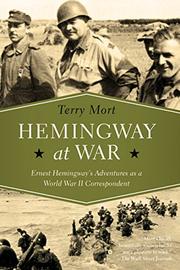
David Hendricks published a review of a new book by Terry Mort, Hemingway At War. He found much to admire. I’ll quote directly from the review:
“The two key words in Terry Mort’s new book—“Hemingway” and “War”—carry equal weight. Although Hemingway is the hook for most readers, Mort’s book has long stretches about World War II that have little to do with the Nobel Prize winning novelist who was also a correspondent in Europe for Colliers Magazine. That’s not a bad thing. Mort’s buildup to the D-Day invasion at Normandy and the allied forces liberating Paris and their deadly struggle to cross into Germany is fascinating.
Hem and Hadley
“The Hemingway narrative in the book starts with his romance and marriage to another war correspondence, Martha Gellhorn, Hemingway’s third wife. Hemingway himself engaged in the war while living in Cuba as World War II began, patrolling the Cuban shores to hunt down German U-boats. This period was fictionalized in Hemingway’s Islands in the Stream. Gellhorn left Hemingway in Cuba to report news in Europe, a move he ultimately followed in 1944 in time for D-Day. Mort alternates between the war and Hemingway’s exploits as a war correspondent.
“He also follows the novelist as Hemingway’s marriage to Gellhorn dissolves and he romances Mary Welsh, yet another foreign correspondent who became his fourth wife.
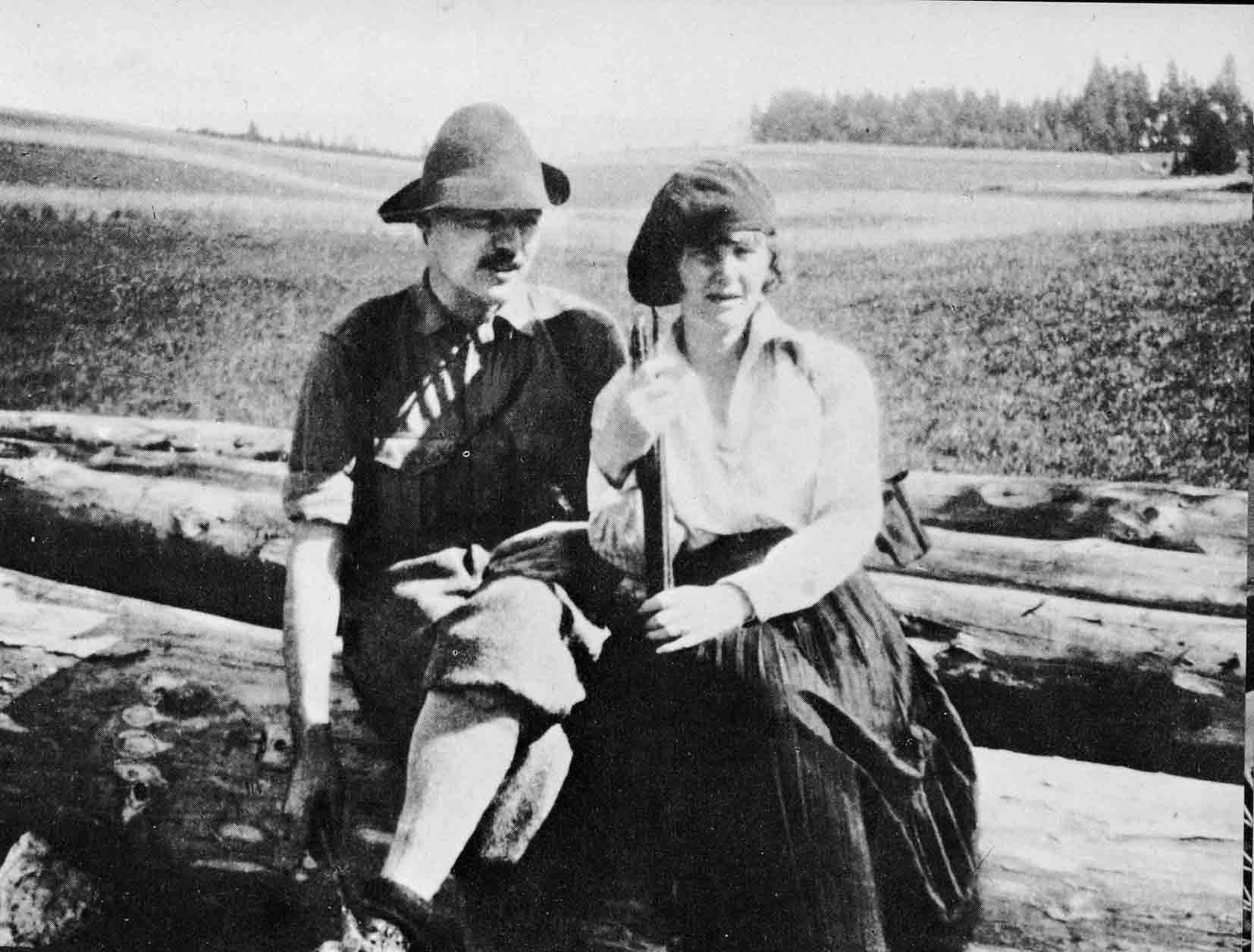
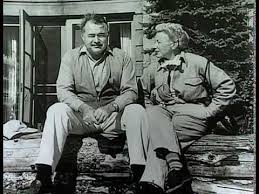
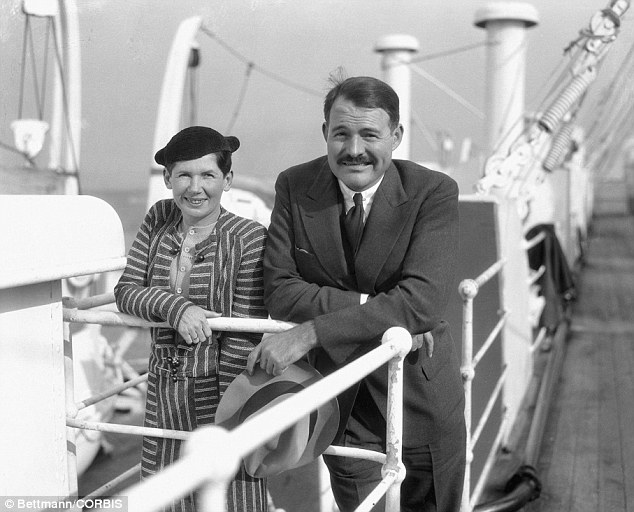
Caribbean surveillanceMartha and Hem shortly after their marriage
“Mort does not idealize Hemingway and the main point of the book’s first half is to demonstrate that Hemingway was a poor war correspondent, at least in comparison with others such as Ernie Pyle, Edward R. Murrow, and Walter Cronkite.
Hem and Mary
“He did show bravery in certain episodes and suffered several head injuries. Hemingway actually landed with allied troops on D-Day at Omaha Beach, certainly a courageous act.
“Hemingway At War, demonstrates a trend that seems to have no end—that as meritorious as some of Hemingway’s novels are, it is his vigorous life and outsized personality, more than his books, that provide continuous grist for interesting history books.”
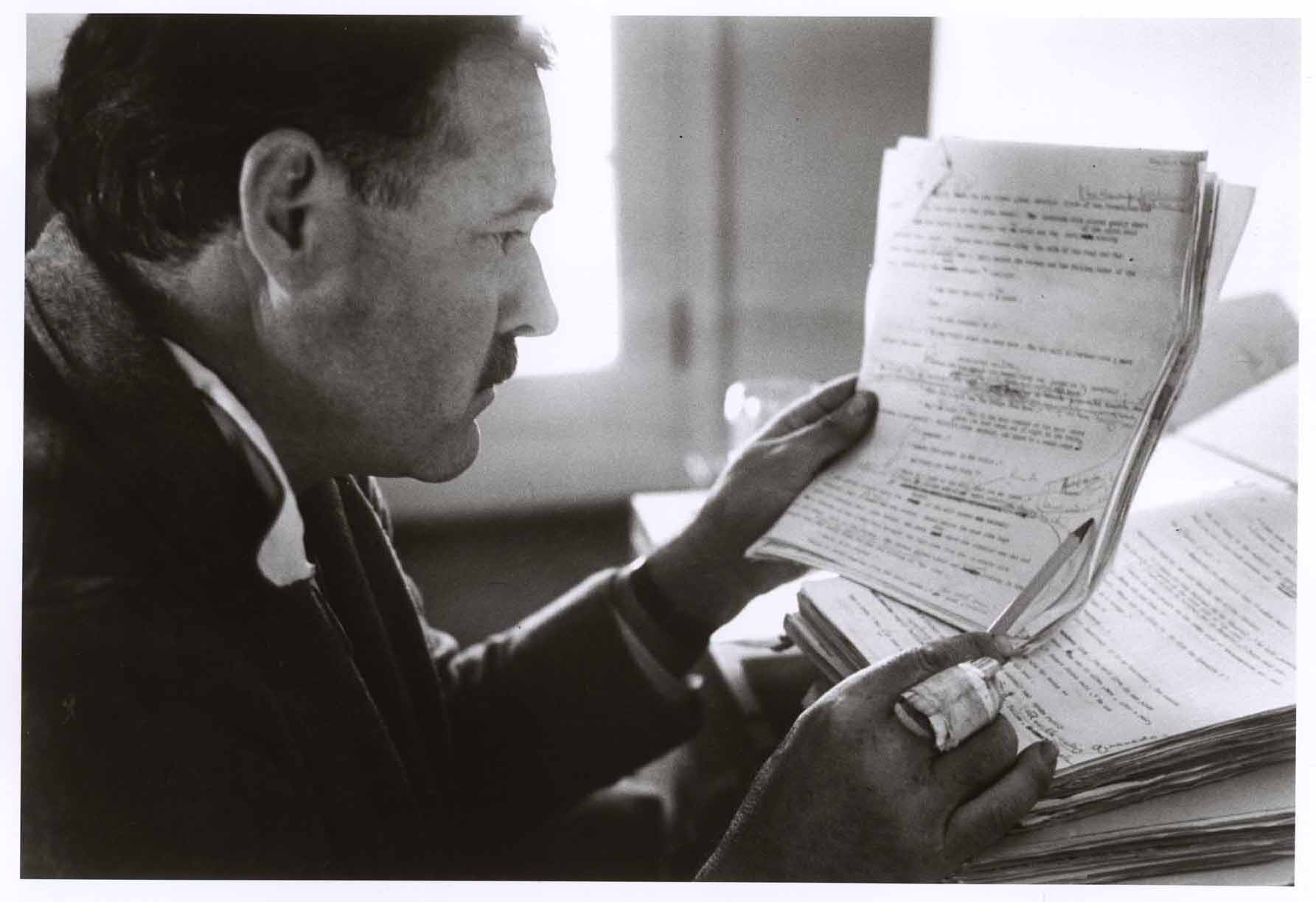
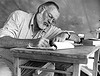
Working
So, I would say that Mr. Hendricks enjoyed the book and feels that it added to the Hemingway legend and full involvement in the second war.
Kirkus felt it was too short on facts. So take a look and you decide.
Hemingway At War: Hemingway’s Adventures as a World War II Correspondent, by Terry Mort.
very cold Martini, Hemingway’s favoritebut not while editing
This was a famous saying from Hemingway but science is now backing it up. While it’s a cool saying, in reality, it was pretty rare that Hemingway wrote drunk. While writing, he tended to follow a very rigid schedule of getting up early, working until the early afternoon and then stopping. He also liked to stop writing only when he knew what was happening next in his story or novel, so he could start with a jolt the following day. When once it was suggested that he wrote drunk, his response was “Jeezus Christ! Have you ever heard of anyone who drank while he worked? You’re thinking of Faulkner. He does sometimes and I can tell right in the middle of a page when he has had his first one. Besides, who in the hell would mix more than one martini at a time?”
William Faulkner
An Australian blog, The Expert Editor, recently wrote about the science behind writing drunk and editing sober. Using a variety of studies, the author concluded that at a fairly low threshold of alcohol, the brain actually is stimulated in creative ways the sober brain might not be. “The part Hemingway got wrong however is that at the point of legit drunkenness, the quality of one’s writing goes south pronto. The author of For Whom the Bell Tolls may have built up an elephantine tolerance for alcohol to the point where he could drink a fifth of whiskey and still crank out prose that would be studied decades later.”
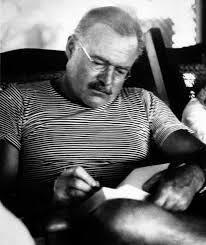
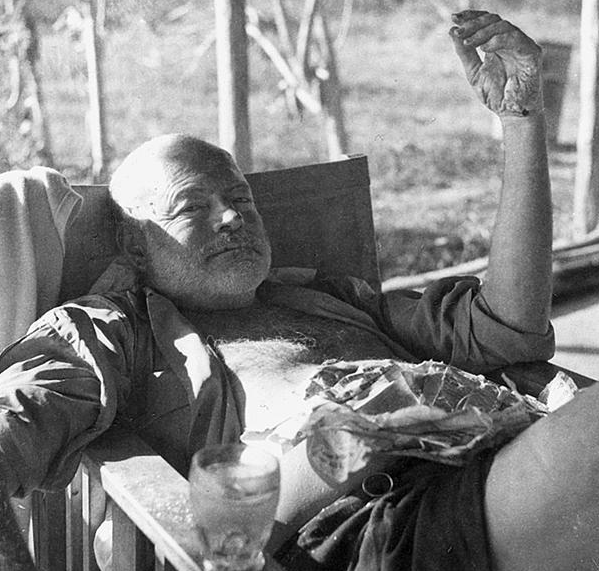
Not drinkingPerhaps drinking after writing.. This particular photo is while on a safari.
But again, while there is no question that Hemingway did become an alcoholic, he was not writing his masterpieces drunk. he took writing way too seriously for that. He might drink later in the day, but not while he was creating.
The science seems to suggest that because alcohol suppresses certain responses and makes you less focused because it decreases your working memory, you start to care less about what is happening around you and enables you to “think outside the box.” Creativity is your ability to think of something original from connections made between preexisting ideas. Apparently, the idea is to be tipsy but not drunk, at which point your focus becomes too diminished to hit that creative synapse.
Too much caffeine?
The article goes on to note that it would be imprudent to edit while drunk. Try editing while having coffee. Coffee has the opposite function of alcohol because caffeine provides more working memory so that as we focus on a task we can make those changes. Coffee also helps you to ignore distractions while editing your own work.
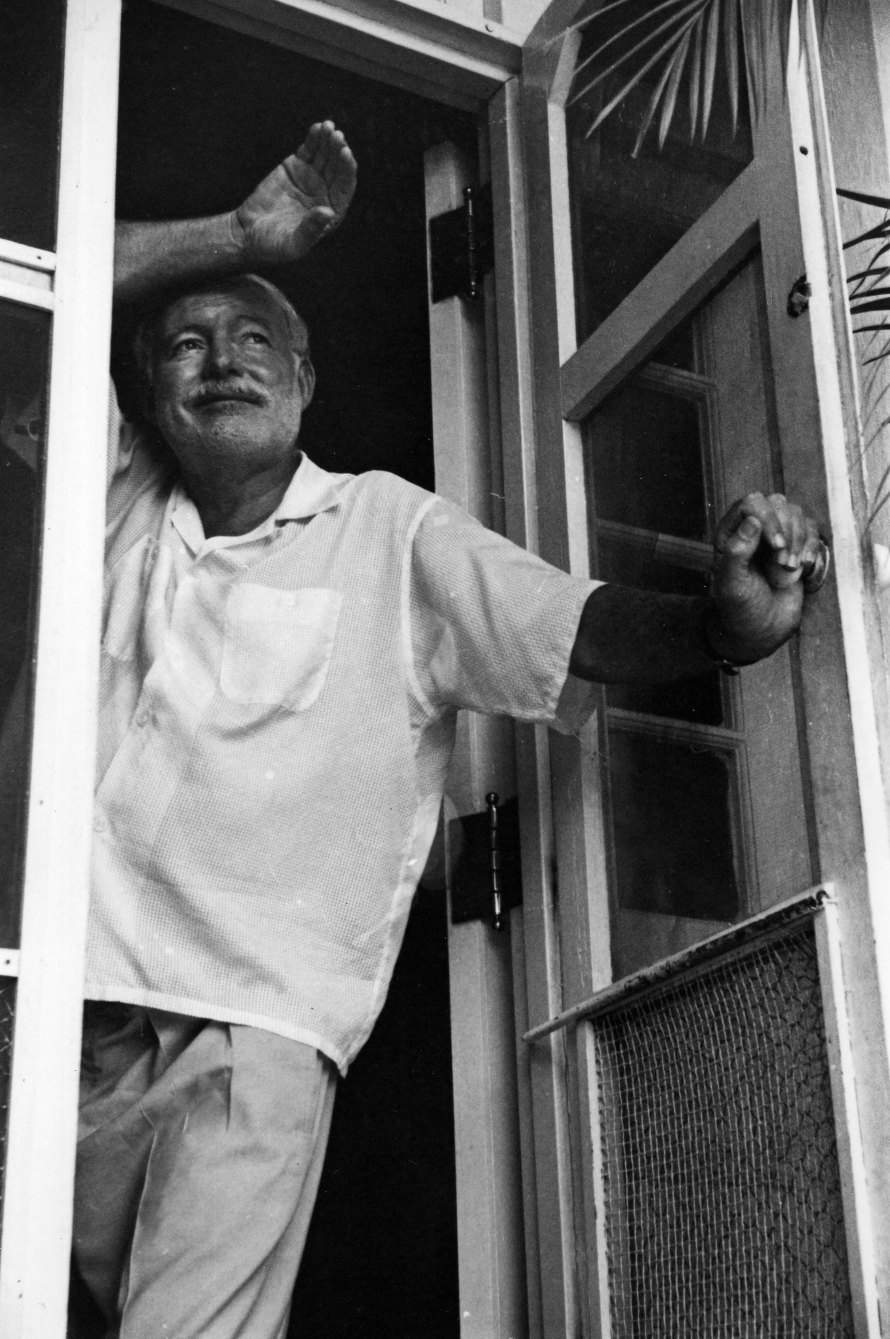
Hem in Cuba
Hemingway used to edit as he went along but then he would put it aside and look at it afresh. For those of you who are writers, you are likely familiar with rereading your own writing so many times that you just have no perspective anymore and your eyes are hopping over edits that should be made. Sticking your manuscript in a drawer for a while is not a bad idea. Things you never saw before all of a sudden jump out at you. What you thought was clever now seems contrived and your witty dialogue feels forced.
A Moveable Feast
So, there you have it. Hemingway backed up by science, ye of little faith.
NEWS ARTICLE
HPMEC FINALIZES PLANS FOR SPRING TRIP TO CUBA
02/08/2017
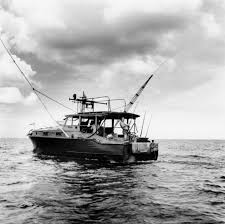
on the Pilar
PIGGOTT — Several openings are still available for a unique trip to Cuba in May presented by the Hemingway-Pfeiffer Museum and Educational Center.
2014 Trip to Cuba Members of the travel party who visited Cuba in 2014
This “Friends of the Pfeiffers” trip will follow writer Ernest Hemingway’s footsteps from his novel Islands in the Stream. This small, guided trip is open to the public and will feature visits to the beautiful and virgin cayos (keys) along the pristine central coast, and with sites associated with Hemingway’s time in Cuba and other traditional sites in Havana.
Hem and Pauline Pfeiffer
Hemingway lived in Cuba for 21 years. During his time there, he wrote The Old Man and the Sea (for which he won the Pulitzer Prize) at the home he called Finca Vigía or “lookout farm,” located nine miles outside of Havana.
This eight-day/seven-night trip will have two parts. First, the group will travel to Havana to enjoy the art, music, dance and architecture of the city. Travelers will enjoy a private reception with the curator of Finca Vigía, explore Old Havana (a UNESCO World Heritage Site), and see the amazing architecture in central Havana as well as stop at many of Hemingway’s favorite places: Hotel Ambos Mundos, La Bodeguita del Medio, El Floridita, and Sloppy Joe’s.
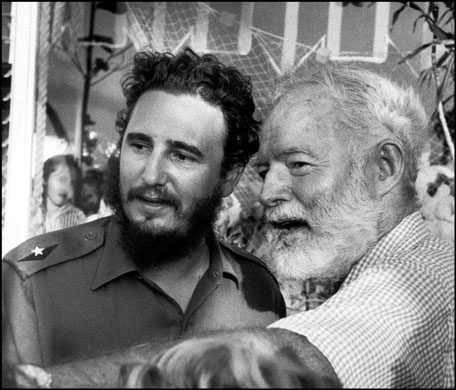
Hemingway and Castro
In addition to sites specifically associated with Hemingway, travelers will also get to enjoy some of the Cuban classics, including a visit to the Rum Museum, a ride in a classic American car and a visit to a cigar factory.
Cadillac in Havana
Part two will be an exploration of the keys off the central coast, Cayo Coco and Cayo Guillermo, which provided the backdrop for Hemingway’s Islands in the Stream. Guests will have an opportunity to interact with the locals for optional activities including fishing, diving, snorkeling, hiking, bird watching, or just exchanging ideas with other Hemingway lovers.
This is the museum’s second trip to Cuba. Thirty-four travelers from 10 states joined the museum for a trip in 2014. To register for the trip, or to get pricing or other information, contact the museum at (870) 598-3487 or adamlong@astate.edu.
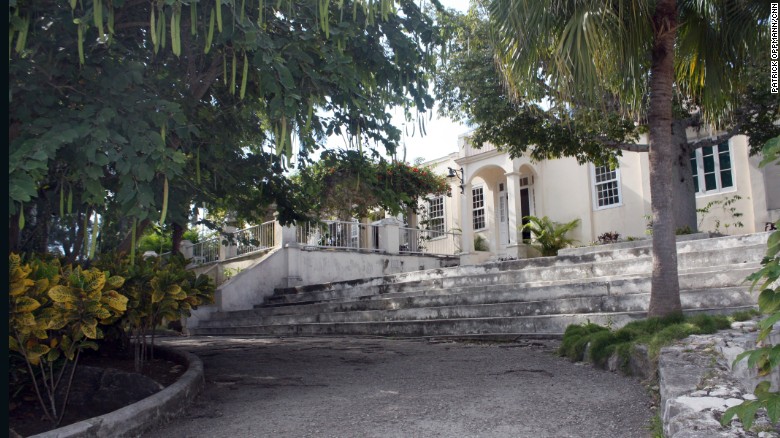
Finca Vigia
HPMEC is an Arkansas State University Heritage Site. Regular museum hours are Monday – Friday, 9 a.m.–3 p.m., Saturday, 1-3 p.m., with tours on the hour.
I always think of Hemingway and Fitzgerald somewhat together because of their beginning in Paris. They had a falling out early on in their relationship and Fitzgerald died in 1940 at the age of 44, well before Hemingway’s who died in 1961. However, it is hard to avoid thinking of the early years, the promise, the romance, the excitement of a new direction in writing. Both were originals and true to their visions (well for the most part. Fitzgerald was not happy with writing for Hollywood in lieu of penning a great novel.) And you can’t think of Scott without Zelda. There is a new series about Zelda. Please read Ms. Felsenthal’s take on it all. The article was printed in Vogue and i have lifted only the first third. There is also an interview with Christina Ricci. And I added the photos. Love, Christine
by JULIA FELSENTHAL
You probably have some less-than-flattering preconceived notions of Zelda Fitzgerald, and there’s a good chance you cribbed them, at least indirectly, from Ernest Hemingway. In A Moveable Feast, his posthumously published (1964), now-beloved memoir of ex-patriot life in 1920s Paris, Hemingway wrote extensively about his good friend, the writer F. Scott Fitzgerald, and about Fitzgerald’s muse, his wife Zelda, the entrancing, free-spirited flapper extraordinaire. Except in Hemingway’s telling, she was actually a cruel, frivolous, controlling harpy who jealously undermined her husband’s success, manipulated him into a life of hard-drinking, and even convinced him he was too poorly endowed to keep a woman happy. When Zelda’s erratic behavior landed her in an institution (her diagnosis was schizophrenia, though we now speculate she might have been bipolar), Hemingway was pleased that it meant his poor put-upon buddy could finally get some real writing done.
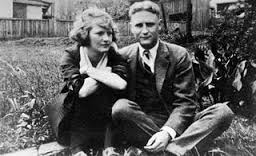
Scott and Zelda
The first season of Z takes place years before all that: Zelda is the belle of the ball in Montgomery, Alabama, less the wild child we’ve read about, and more an actual child testing out the boundaries of her rebelliousness. Then she meets a very young, enlisted F. Scott Fitzgerald (David Hoflin), stationed near Montgomery before shipping off overseas (the war would end before he had to), a Minnesota-born Princetonian who dreams of becoming a great writer and who has already incubated a not-so-great drinking problem.
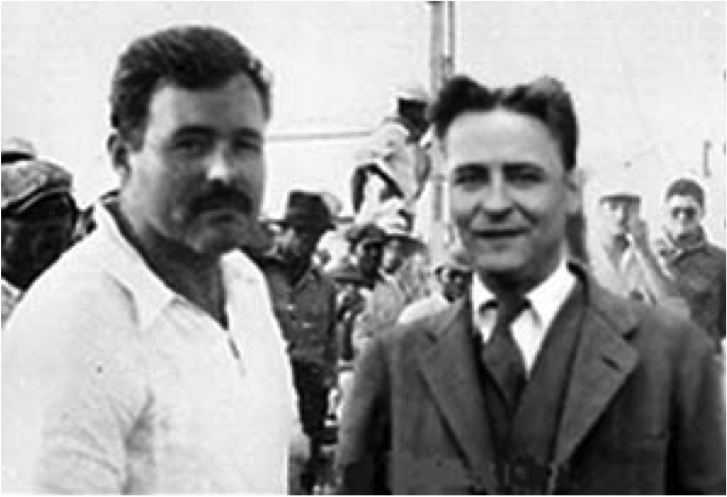
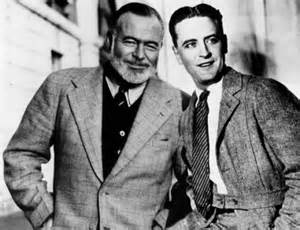
Hem and Scott
The first few episodes of Z feel a little bit like Roaring ’20s Muppet Babies: a sunny, sanitized, myopic romp through the scrappy early years of a pair who would one day become icons of their age. But as the skies darken over the Fitzgeralds’ charmed life, the show becomes an unremitting examination of a complicated marriage in the early stages of curdling, and a kind, but not wholly apologetic spotlight on Zelda, who is struggling in real time to keep up bon vivant appearances, to keep her husband productive, and to locate any sense of personal creativity within a partnership that’s proving as stifling as Montgomery ever was.
Zelda in ballet slippers
We watch as Scott nixes Zelda’s acting aspirations and unabashedly mines her diaries for his own fiction. (Literary history goes that he would also later publish her stories under his name—he commanded the bigger paycheck—and that he excised from her only novel, Save Me the Waltz, biographical material that he wanted for his Tender Is the Night.) We also watch as Zelda’s unrealistic lifestyle-demands and ravenous appetite for novelty keep her husband away from his work.
Was F. Scott Fitzgerald the domineering husband who squashed his wife’s potential, or was she the succubus who ruined him? In the first season of Z it’s too early to tell, though the show seems far more interested in exploring the murky corners of their flawed coupling—the very definition of can’t live with/can’t live without—than it does in issuing a final verdict.
ScottMax perkins, shared editor at Scribners
When her novel came out, The New Yorker criticized Fowler for smoothing out her character’s rough edges. Her Zelda was “easy to relate to even as she runs wild, sensible while allegedly insane.”
Ricci’s Zelda is no less relatable. We are, after all, in the age of the anti-heroine, when empathizing with women behaving badly is a thing. But in the actress’s hands, the character is also enigmatically feral. Her Zelda is unpredictable to a fault, a prisoner of her own racing mind, whose vagaries often lead her into situations she’s ill-equipped to handle. There’s always something roiling behind the actress’s eyes, a charge that makes her electric to watch.
Zelda and Scott, Midnight in Paris
“Our hope is that this for people is almost like a first-person experience,” Ricci told me over the phone. “It really gives you the time to go through her life with her. You feel more intimacy.”