

Once there was a traveller who journeyed alone to the Grand Canyon. He came to the brink just as the day died, and the slow mists circled upward. There he stood and he looked.
And there came, from behind him, the sound of footsteps—large, firm steps dealt by the accustomed feet of a lady tourist. She gained his side and stopped there, radiating native friendliness and the good cheer provided by Fred Harvey. She, too, looked. And woman’s world-old need of speech seized her, and seemed as if it would rack her very tweeds apart.
“Well!” she said. “It certainly is attractive.”
And I feel, my friends—for I think of every one of you gathered here tonight as my friend, and I want you to think of me that way, too!—I feel not unlike that good lady of the Canyon when I am asked by this hospitable house-organ to speak a few words about Ernest Hemingway. Well! He certainly is attractive.
For it is so neat in my mind that the author of “In Our Time,” “Men Without Women,” and “A Farewell to Arms” is far and away the first American artist, that it is the devil’s own task to find anything more complicated or necessary to say about him.
It is no misses’ size assignment to dash off a description of Ernest Hemingway, Writer and Human Being. One hesitates, in the first place, to add to the measure of bilge that has already been written; probably of no other living man has so much tripe been penned and spoken. And it is the present vogue to rip off sketches of the famous in a sort of delicate blend of the Anecdotal, or Brightest-Things-Our-Baby-Ever-Said, manner, and the Tender, or Lavender-and-Old-Rubbers, school. As a subject, Mr. Hemingway does not lend himself to the style. He will not—indeed, it is my belief that he can not—pluck you down from his memory any cobwebby pretties about his favorite school-teacher; nor will he help you along with your work by uttering Good Ones that you can set promptly on clean white paper. There are anecdotes about him, and beauties, too; and there are quotations from his conversations that, I think, must pass eventually into folk lore. But I may not give them to you here. I am sorry but I really can not feel that we are well enough acquainted for that. Mrs. Parker to you, if you please.
But people want to hear things about Ernest Hemingway. As the boys used to say, before they left the phrase flat and ran off in all directions with “gesture,” “good theatre,” and “the American scene,” he intrigues the imagination. People so much wanted him to be a figure out of a saga that they went to the length of providing the saga themselves. And a little peach it is.
I have heard of him, both at various times and all in one great bunch, that he is so hard-boiled he makes a daily practice of busting his widowed mother in the nose; that he dictates his stories because he can’t write, and has them read to him because he can’t read; that he is expatriate to such a degree that he tears down any American flag he sees flying in France; that no woman within half-a-mile of him is a safe woman; that he not only commands enormous prices for his short stories, but insists, additionally, on taking the right eye out of the editor’s face; that he has been a tramp, a safe-cracker, and a stockyard attendant; that he is the Pet of the Left Bank, and may be found at any hour of the day or night sitting at a little table at the Select, rubbing absinthe into his gums; that he really hates all forms of sport, and only skis, hunts, fishes, and fights bulls in order to be cute; that a wound he sustained in the Great War was of a whimsical, inconvenient, and inevitably laughable description; and that he also writes under the name of Morley Callaghan. About all that remains to be said is that he is the Lost Dauphin, that he was shot as a German spy, and that he is actually a woman, masquerading in man’s clothes. And those rumors are doubtless being started, even as we sit here.
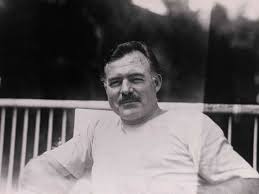
For it is hard not to tell spectacular things of Ernest Hemingway; people are so eager to hear that you haven’t the heart to send them away empty. Young women, in especial, are all of a quiver for information. (Sometimes I think that the wide publication of that smiling photograph, the one with the slanted cap and the shirt flung open above the dark sweater, was perhaps a mistake.)
“Ooh,” they say, “do you know Ernest Hemingway? Ooh, I’d just love to meet him! Ooh, tell me what he’s like!”
Well, I warned you the task sinks me. Ernest Hemingway is something—not exactly—like this:
He has, I should think, the best and the worst times of anybody living; he experiences several examples of both, every day. He has an uncounted number of interests, and a passionate concentration. Whatever he does, he goes in for hook, line, and good red herring. He has a generosity of energy that is absolute. He has a capacity for enjoyment so vast that he gives away great chunks to those about him, and never even misses them. I can say no more of him than that he can take you to a bicycle-race, and make it raise your hair.
He is in his early thirties, he weighs about two hundred pounds, and he is even better than those photographs. The effect upon women is such that they want to go right out and get him and bring him home, stuffed. Heaven help him, if he ever settles in New York and is displayed to the sabre-toothed ladies of stage, pen, salon, and suburb who throng the local Bohemian gatherings. He is susceptible to flattery, and then is stuck with the flatterer. He is afflicted with deep-seated illness in the presence of unhappily married women who are interested in the Arts.
His father was a Middle-Western doctor. I can find out nothing about his education—probably he read a lot of things. Anyway, he left home at something below the conventional early age, with the englamoured idea of being a prizefighter. (He was a bad prizefighter, so he is now a good amateur boxer.) Then he became a reporter, somehow, and then he went abroad, and Then Came the War, and there he was, in the Italian army. He suffered seven major wounds, and has a life-sentence to wear an aluminum kneecap. He received medals; it makes him sick if you ask him about them. He does not talk about the War, especially if you lead up to it.
He lives, for a bit of every year, in Paris—which is how the expatriation stories started. He and his wife do this because they like it, and because their rent is not high. (He doesn’t make much money—not half as much as you do.) They form no part of the dancing-and-light-drugs life of the French capital. Their apartment has no telephone; and any engagement made by telegram, letter, or word-of-mouth for a time set several days ahead throws Mr. Hemingway into one of those states of his—he hates anything, bad or fair, hanging over him. He writes there, mostly in bed, and he reads books that have a great many things going on in them—novels by the elder Dumas, and books and books and books about the Crusades.
When the Hemingways come to the United States, they dwell in the outlands. Their baby was born in Arkansas, and they spent last Winter in Key West, deep-sea fishing, and killing with harpoon or gun the major items of their menus. He avoids New York, for he has the most valuable asset an artist can possess—the fear of what he knows is bad for him. Somehow, you can not fit him into the jig-saw puzzle of New York life. Drink he does and did and will again, but he was not designed for night-clubs, and it is virtually an impossibility for him to speak easy. The mind refuses to function over the idea of his presence at a literary tea, or an evening of parlor games. Nor is his ambition beckoned toward the North Shore of Long Island. “Scratch a writer,” once I heard him say, “and find a social climber.” But nobody, including himself, can be with him, and keep remembering that he is a Writer.
With the possible exception of Ring Lardner, he is less the literary character-part than any author I have ever seen. Nothing is done about the thrill of creating, nor the need for expression, nor even the jolly good fun of spinning a yarn. He works like hell, and through it. Nothing comes easily to him; he struggles, sets down a word, scratches it out, and begins all over. He regards his art as hard and dirty work, with no hope of better conditions. He listens, with something of the expression of the tattered orphan outside the bakeshop window, to the literati’s tales of the necessity of still and pleasant surroundings and the employment of expensive devices to ease the gestating mind. Once he heard the odyssey of a highly-valued American writer; an account of ceaseless, fruitless flights to the more luxe, yet recondite, nooks of the globe, in quest of what was called “a good place to work.”
“—————,” Ernest Hemingway said, mentioning a certain word by name, “the only good place to work is in your head.”
Seventy times he rewrote the concluding pages of “A Farewell to Arms.” He had no idea of ever being completely satisfied with them; he merely hoped that the words would eventually come nearer to his meaning. The pile of scribbled-out sheets made a formidable manuscript. Seventy times . . . “Now I suppose,” he remarked, “they’ll say that the ending is hurried.”
He is outrageously sensitive to criticism—probably because his work has begot some specimens that should really be preserved in alcohol. The American Mercury dismissed “In Our Time” as “sketches in the bold, bad manner of the Café du Dôme.” A certain young gentleman dedicated to beautiful letters confessed with a sort of laughing pride—in the pages of an organ also dedicated to beautiful letters—that he just wasn’t able to “understand some of the stories in ‘Men Without Women.’ ” There was another young gentleman who once occupied the editorial chair of a now defunct magazine of culture, and sought, from there, to form the taste of the American public; he was shown some of Hemingway’s work, then unpublished in the United States, refused it, and pronounced, “I hear he has been a reporter—tell him to go on reporting and not try to write.”
As I wrote this, the reviews of “A Farewell to Arms” had not yet reached Ernest Hemingway in Paris. All those by what are called the big critics may be laudatory, serious, and understanding; but it is safe to say that if there be included among them one tiny clipping announcing that Miss Harriet McBlease, who does “Book-Looks” for the Middletown Observer-Companion, does not find the new Hemingway book to her taste, that will be the one Our Hero will select to brood over. . . .
He has an immense, ill-advised, and indiscriminate tenderness. It is nice to note, by the dust cover of a recent novel, that its author is “a Hemingway become compassionate,” and one hastens to congratulate the lad on what must be such a pleasant change; but the original model was compassionate to start with. As always happens, the people for whom he is sorry eat greedily into his time. He is far more lavish with his sympathy than with his friendship. That goes in few directions, and is given with a little lingering, as if in the expectation of betrayal. But once you have it, there it is, and neither neglect nor bad usage can touch it.
Well—I told you it would sink me. Ernest Hemingway is something—not exactly—like that.
Questioners, in my experience, never conclude with the “What’s he like?” number. There is always one more interrogation, put in a delicately lowered, and yet lightly rippling, voice. “Does he,” it runs, “does he talk like he writes?”
Yes, he does talk like he writes. In fact, liker. But how do you know what his writing is like, when you can see in it only the rough words? (At least, that’s what I always mean to answer, and I may get around to it any day.)
It is a strange thing about Ernest Hemingway. Somebody—the public, the city of Boston, a blurb-writer, a reviewer, somebody—has bandied his name about until it has become a synonym for profanity generously laced with obscenity. They read him, and, with a nudge and a snicker, let him go at that.
The title of this interesting composition is taken, unasked, from a letter from Ernest Hemingway to his friend, Scott Fitzgerald. “I am now,” he wrote, “in the state of depression where you’ve gone over and over until you can’t tell whether anything you’ve written is any good or not; this is called the Artist’s Reward.”
And Mr. Hemingway has gained an additional, and an equally comforting, prize for his travail. He has lived to see any writer who employs the word “bastard” hailed as “another Hemingway.”
There is a thing about him that I have not yet mentioned, for I am a slow worker. He has the most profound bravery that it has ever been my privilege to see; and I am not the one who over-readily discerns examples of courage among my opposite sex. He has had pain, ill-health, and the kind of poverty that you don’t believe—the kind of which actual hunger is the attendant; he has had about eight times the normal allotment of responsibilities. And he has never once compromised. He has never turned off on an easier path than the one he staked himself. It takes courage.
That brings me to the point which I have been trying to reach all this time: Ernest Hemingway’s definition of courage—his phrase that, it seems to me, makes Barrie’s “Courage is immortality” sound like one of the more treble trillings of Tinker Bell. Mr. Hemingway did not use the term “courage.” Ever the euphemist, he referred to the quality as “guts,” and he was attributing its possession to an absent friend.
“Now just a minute,” somebody said, for it was one of those argumentative evenings. “Listen. Look here a minute. Exactly what do you mean by ‘guts’?”
“I mean,” Ernest Hemingway said, “grace under pressure.”
That grace is his. The pressure, I suppose, comes in, gratis, under the heading of the Artist’s Reward. ♦