
Reject Half of Hemingwayism
Response to Ozy Brennan – there are still some things we should learn from Hemingway
I remember reading Hemingway in high school American lit class: The Sun Also Rises , “Hills like White Elephants,” and maybe some others – I don’t remember everything we read there. He wasn’t my favorite author, but he wasn’t anywhere near the worst we read that term. I remember his sparse, bald style – which went well with the sparse baldness of his themes.
So, when I read Ozy Brennan’s recent post “Reject Hemingwayism“, I immediately had a lot to say. I agree with Ozy on a lot of points, but there are some important points that writers should learn from Hemingway. Hemingway did write well – and he wrote a specific type of story, but there are still some good lessons to take from him more generally.

To start with, I agree with Ozy against Hemingway that writers shouldn’t hesitate to show melodrama.
Hemingway’s stories are a specific sort of story. He was trying to write bald stories with bald facts and setting, to show the world as it is rather than as it might be dressed up to be. “Many are strong in the broken places,” as he said in Farewell To Arms.
And to him, and to the Lost Generation of which he was a member, they must first come to terms with the brokenness as it is. Melodrama was meaningless, lost in the carnage and waste of World War One. His characters don’t cry, because they’ve been through far worse. His readers don’t expect them to cry, because they the readers have also been through far worse.

Hemingway-style restrained characters definitely do have a role. When I was acting in my first amateur theater play as a teenager, my dad introduced me to the effect of understated emotion. I was playing a butler in this one scene, with just a few lines in the background – and my first impulse was to visibly react to the events on stage, but my dad showed me how much power there can be just a few raised eyebrows and understated reactions.
It can be almost as powerful in print as on the stage. But not every character should be that way. In fact, such characters – like Mr. Spock in Star Trek – can be even more powerful when contrasted with more-emotional characters around them. As scriptwriter David Gerrold said, Spock’s lack of emotion is good specifically because of the emotion it evokes in the other characters.
 (Is this masculine, as Ozy suggests some think? A certain sort of masculinity, probably. But the entire medieval tradition to which Tolkien was alluding practices a different sort of masculinity.)
Hemingway doesn’t show this contrast. He’s going for a different sort of effect – and he does it well, but it’s an effect I don’t care to read that often. I certainly don’t want every book to have that effect, either.
Hemingway’s style of words, though, is more complicated.
“It’s true,” Ozy says, “that adverbs and adjectives can be crutches used to sustain a weak noun or verb: “he went slowly” instead of “he strolled.”” And therefore, Hemingway’s famous writing advice is to find the right noun and verb rather than dressing up a weak one. Against this, Ozy holds up several example passages, and concludes “English didn’t evolve several parts of speech, multiple punctuation marks, and half its vocabulary because they’re stupid useless things that no good writer would employ.”
I agree, as such. However, this’s minimizing the importance of Hemingway’s advice. As Twain put it, “The difference between the almost right word and the right word is… the difference between the lightning bug and the lightning.” Finding a strong word is much stronger than dressing up a weak word. Ozy quotes good authors who use adverbs and adjectives well, but this’s much more important for newer authors who don’t necessarily have the talent to tell how to use them very well.
Before my high school lit class where I encountered Hemingway, I read a writing advice column – I don’t remember by whom – which gave the same advice: don’t dress up weak words, but use strong words. I still agree.
To pick one of the writers Ozy quoted, Tolkien: there’s a reason we remember lines like “Renewed shall be blade that was broken; the crownless again shall be king.” There’re only two adjectives in that couplet; one of them (”broken”) is a participle and the other (”again”) tells us the order of events. None of these words are “fancy Latinate words” or otherwise unusual; like Hemingway, Tolkien is giving us sparse, simple language.
Tolkien is using simple language here for a reason – or specifically, two reasons. In-universe, this’s a poem composed by Bilbo the Hobbit; Tolkien is doubtlessly making a point of having him use simple language hearkening back to the simple Shire. Beyond that, it’s a poem composed about Aragorn who is the lost king returning to his throne; the simple language casts our minds toward the simple ancient fairy-tale theme.
Complex language wouldn’t fit the same.
Tolkien does this very well throughout his works. He uses unusual sentence constructions, but usually simple sentences. For example, when the Fellowship is leaving Rivendell:
The Company took little gear of war, for their hope was in secrecy not in battle. Aragorn had Anduril, but no other weapon, and he went forth clad only in rusty green and brown, as a Ranger of the wilderness. Boromir had a long sword, in fashion like Anduril but of less lineage, and he bore also a shield and his war-horn.
What adjectives are here? Few, and ordinary. The continued simple words have their own effect. The old-fashioned constructions (like “their hope was in secrecy” or “he bore also”) give us a different sort of effect that doesn’t violate Hemingway’s rules and is even stronger because of it.
In fact, it’s much briefer on the page than it might seem in our memory. The description of Cerin Amroth which Ozy quotes is one short paragraph, but as Tolkien scholar Michael Martinez puts it, “Tolkien’s conciseness in sharing details provides that illusion of long writing.” It looms much larger in our memory than on the page, because of Tolkien’s strong words.

So, it might seem proper for people writing different themes to use different styles. As Ozy says, Catherynne M. Valente’s Space Opera reads differently from a more bald factual stating of the Fermi Paradox.
I agree! This is a corollary of the narrator being a character in your story. Your narrator shouldn’t be Hemingway’s narrator, unless you’re writing a story where Hemingway’s narrator makes sense.
Yet one must not forget the lessons of Hemingway’s style.
Finding the right words means something. Even if you’re writing a passage as ponderous with adjectives and adverbs as Gormenghast , finding the right nouns and verbs matters. Or, to take Ozy’s other quote, from Tolkien: Aragorn “ was wrapped in some fair memory,” and “ the grim years were removed from the face of Aragorn, and he seemed clothed in white”. Note the strong participle “wrapped” and the classical “clothed” rich with connotations (including Biblical connotations which I think Tolkien fully intended here.) I don’t see many adjectives and adverbs or advanced constructions here. In fact, Tolkien’s prose seems almost as bald as Hemingway’s!
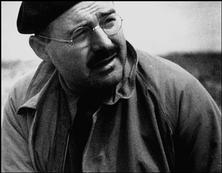
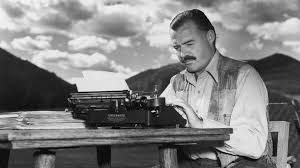
In December 1937 Ernest Hemingway was covering the Loyalist assault on Teruel, the walled town in the bleak mountains of Southern Aragon, Gen. Franco was planning to use this corridor route to the Mediterranean thus seaparting Barcelona from Valencia and Madrid. Robert CAPA the photographer and Hemingway would with some colleagues drive daily to Teruel from Valencia and return each evening.
Valencia. Dec. 1937. Hemingway visiting the front line.
Ozy laments Hemingway’s influence on modern prose.
When I tried to think of examples, for a while, I couldn’t. I wished Ozy had pointed out more examples. Maybe that’s because I don’t read the same sort of books – I definitely know I haven’t read much “literary fiction”. But if there’s a parade of authors aping Hemingway’s style – I haven’t seen it.
(Or, well, I have seen it in one place: amateur authors writing online what might be their first-ever stories. Sometimes, they tack much too far into Hemingway. But other times, they tack much too far into the opposite pit-trap and drown us under a tsunami of adjectives and adverbs.)
But then I reread Ozy’s post and realized: I’m not noticing Hemingway’s influence because I’m already swimming in it.
Though modern novels haven’t aped Hemingway’s style, they’ve been influenced by it: they’re much balder than nineteenth-century novels. Modern novels – even Valente – use fewer adjectives, and less melodrama, than (say) Charles Dickens or Jules Verne. This probably isn’t just Hemingway – Hemingway was one exemplar of a movement around his time – but Hemingway can be a synecdoche for this very real movement.
Is this a bad thing? Probably. On the one hand, modern authors are building off a longer tradition than Dickens, so they can do things more artfully (just like I discussed about playwrights earlier). If authors can produce more sentiment and more vividness with fewer narrative asides and fewer individual adverbs, that’s not bad. But looking back, I do feel the effect built by modern novelists is poorer in some ways. Imagine A Tale of Two Cities without the narrative comments, or the famous beginning!
Modern readers don’t expect the melodramatic effect or description of Dickens or Verne. Even when they’re reading melodrama, it’s not the same sense of melodrama.

But, that tide can shift. But I wonder how the sentimental ear of Dickens’ narrators would feel to a modern audience. If it’s artfully written, especially if the narrator is characterized well themself, I suspect it could go well.
So, to aspiring writers, Hemingway does have at least one important lesson: use vivid nouns and verbs, without depending on adjectives or adverbs to dress up weak words.
But at the same time, all in all, I agree with Ozy on a literary level: Hemingway’s influence has been too great.